
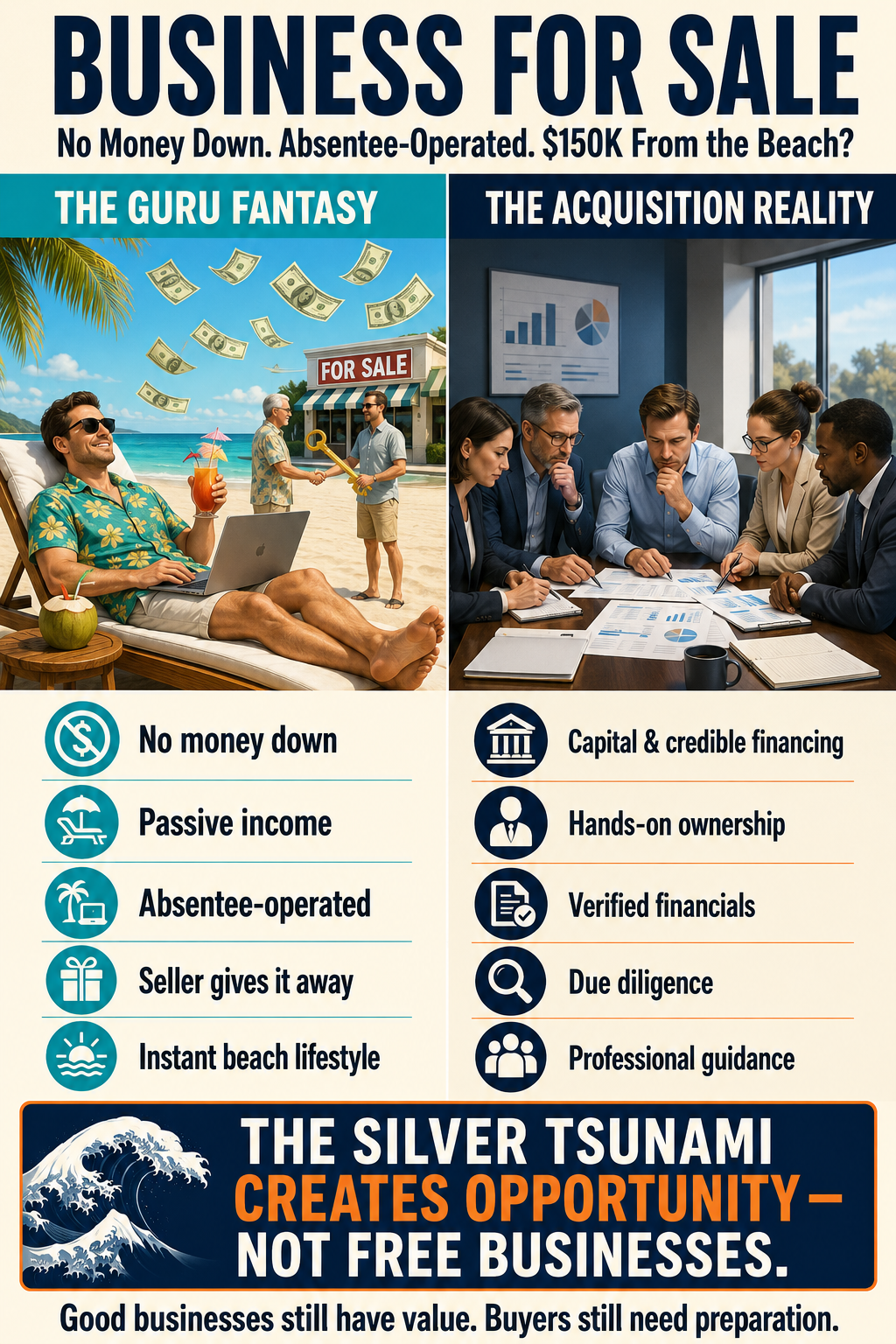
Apparently, America’s aging business owners have gathered for a secret meeting and agreed to give their companies away.
The password is “silver tsunami.”
According to a growing army of social-media gurus, millions of baby boomers are so desperate to retire that they will happily hand you a profitable, absentee-operated business with no money down. The company will already have a loyal management team, pristine financial records, recurring revenue, no customer concentration, and enough cash flow to pay you $150,000 a year while you supervise operations from a beach chair.
Naturally, the seller will finance the entire purchase. No collateral, operating experience, personal guarantee, or meaningful investment required. Just download a few templates, send 500 automated emails, and prepare to become a “business owner.”
Perhaps the seller will even leave the keys under the mat.
The “Silver Tsunami” Story
The silver tsunami is real in one important sense: many business owners are approaching retirement, and a significant number will need to transition or sell their companies.
That does not mean they have lost the ability to count.
A retiring owner may be motivated to sell, but motivation is not the same as desperation. After spending 20, 30, or 40 years building a company, most owners are not eager to transfer it to an undercapitalized stranger whose primary qualification is having watched several acquisition videos.
Sellers still care about price. They care about terms. They care about whether the buyer can close, protect the employees, serve the customers, preserve the company’s reputation, and make the payments after the seller agrees to finance part of the transaction.
In other words, retiring business owners generally want qualified buyers—not rescue missions.
“No Money Down” Usually Means Someone Else Is Taking the Risk
Can a business ever be acquired with very little buyer equity? Yes. Creative transactions happen. Seller financing, SBA loans, investor capital, earnouts, and other structures can reduce the amount of cash a buyer contributes at closing.
But somebody is still funding the purchase and accepting the risk.
A lender may require a down payment, collateral, relevant experience, strong credit, and a personal guarantee. An investor will expect ownership and a return. A seller who finances the deal will want confidence that the buyer can operate the company and repay the note.
That part rarely makes the 30-second video.
“No money down” is more clickable than “assemble a credible capital structure, complete extensive due diligence, accept personal risk, and negotiate terms that work for all parties.”
It also looks much better written across the hood of a rented sports car.
The Mythical Absentee-operated Business
Then there is the absentee-operated business: a company that produces substantial income while requiring almost none of the owner’s time.
These businesses exist. They are also scarce, desirable, and generally priced accordingly.
If a company has stable earnings, reliable management, documented systems, clean books, diversified customers, and minimal dependence on the owner, buyers tend to notice. A strong business does not become cheap simply because its owner was born before 1965.
Most small businesses require meaningful ownership involvement. Employees need leadership. Customers need attention. Equipment breaks. Competitors appear. Costs rise. Key managers leave. Large accounts disappear. Problems have an inconvenient habit of occurring between beach drinks.
A business may be advertised as “absentee,” but buyers must determine what that actually means. Does the owner work five hours a week—or has the owner quietly handed 45 hours of responsibility to a spouse who is not on payroll? Is the management team truly capable, or does every major decision still flow through the seller? Will key employees remain after the transaction?
A listing description is the beginning of due diligence, not the conclusion.
AI Can Produce a Beautiful Plan—and a Beautifully Wrong One
Artificial intelligence has made acquisition advice faster, cheaper, and more polished. It can generate valuation models, due-diligence checklists, negotiation scripts, letters of intent, and 100-day operating plans in seconds.
That is useful.
AI can organize information, compare industries, identify questions, and help buyers prepare. What it cannot do is determine whether the seller’s financial statements are reliable, whether employees will stay, whether customers are loyal to the company or personally loyal to the owner, or whether a first-time buyer can successfully run the operation.
A polished spreadsheet is not verification. A legal-looking document is not legal advice. A confident answer is not necessarily a correct answer.
Technology can accelerate the acquisition process. It can also accelerate bad assumptions.
The Guru Business May Be the Best Business in the Deal
There is real money being made in the business-acquisition boom. Some of it is being made by people buying and operating good companies.
Some of it is being made by selling courses to people who want to buy and operate good companies.
Buyers are paying thousands of dollars for masterminds, coaching programs, automated deal lists, proprietary “systems,” and promises of off-market businesses that practically purchase themselves. The formula is attractive: little capital, low risk, limited work, and immediate cash flow.
If that combination sounds unusually generous, remember that the person promoting it may already know where the easiest money is—in selling the formula.
The Federal Trade Commission has acted against business-opportunity programs that used artificial-intelligence claims and promises of passive income to persuade consumers to invest substantial sums. The FTC also reported that one in three people who lost money to a job or business-opportunity scam in 2025 said the opportunity began on social media.
Apparently, the algorithm is excellent at finding opportunity. It may simply be finding someone else’s opportunity to sell you a dream.
Real Buyers Still Have to Do the Boring Work
The small-business acquisition market offers legitimate opportunity. BizBuySell reported 9,586 transactions in 2025, representing approximately $7.95 billion in total enterprise value.
Those numbers show an active market. They do not show thousands of owners abandoning profitable companies on the side of the road with the engines running.
Successful buyers generally follow a less glamorous process:
- They become financially prepared.
- They set realistic expectations.
- They understand the role they will need to play.
- They investigate the company’s earnings and risks.
- They protect confidentiality.
- They evaluate employees, customers, suppliers, competition, and owner dependence.
- They work with an experienced business broker, attorney, CPA, and lender.
- They accept that every business has imperfections.
- They understand that aggressive negotiation does not automatically produce a better deal.
- They distinguish enthusiasm from evidence.
None of this photographs particularly well beside an infinity pool. It does, however, improve the chances of completing a sound transaction.
The Beach Can Wait
The silver tsunami may bring more businesses to market. It may create opportunities for prepared buyers and viable exit paths for retiring owners.
What it will not do is repeal economics.
Good businesses still have value. Sellers still have options. Lenders still evaluate risk. Buyers still need capital, judgment, patience, and the ability to operate what they acquire.
So, can you buy a profitable, absentee-operated business with no money down and earn $150,000 while sitting on the beach?
Of course.
Right after you purchase the guru’s platinum mastermind, download the secret acquisition template, and discover the hidden marketplace where experienced owners give valuable companies to people with no money, no risk, and no operating responsibilities.
Just remember to bring sunscreen—and a due-diligence team.
Sources referenced: Federal Trade Commission, “FTC Acts to Stop Click Profit Online Business Opportunity” (March 2025); BizBuySell, “2025 Year in Review.”